
Alphabet Photography Project
Inside Passage
Roscoe Inlet


Alaska
Inside Passage
Reflections on Cruising
Southeast Alaska | Reflections on a Season Past (Part 1 of 3)
Monday, January 18, 2016TheCambrians
Sailing to Southeast Alaska is the pinnacle of cruising not only for those of us in the Pacific Northwest , but many cruisers world-wide. It’s one of the
most stunning places on earth and has found its way on more than one bucket list
– for cruisers and landsman alike. And now that the 2015 season is behind us, I
thought it would be a good opportunity to reflect on the time we spent in her
waters. To do that, I’ve written a total of three blogs: one listing the things
we liked about cruising in Alaska Alaska
The Weather
It’s
easy to sit here 3,200 miles and six months later and say that it was the most
incredible season we’ve ever had: David and I saw and did things while we were
there that exceeded our wildest dreams and that we would love to experience
again. But that’s not always how we felt. Cruising to Southeast Alaska can be very challenging and is a lot of hard work,
which is fine; we knew that before going and signed up for it. But we picked a
particularly bad season weather-wise and the work versus reward ration was out
of balance for us a lot of the time.
Things
started off well. The weather was beautiful in May when we arrived; and when
June came around, we found ourselves in a regular pattern with four or five
nice days followed by two or three days of unsettled weather. But then July set in and the heavens opened up: Juneau
We’re
not averse to getting wet. This is the Pacific Northwest and Southeast Alaska
is a rainforest, after all. But we went to Alaska
Commercialization
It
wasn’t just the rain that put a damper on our experience. We found Alaska British Columbia
Sailing
to a Schedule
Another
difficultly we encountered was that we had to sail to a schedule, something we
try to avoid at all cost. But because we wanted to visit Glacier Bay, it
couldn’t be avoided unless we’d arrived early enough in the season to enter the
park boundaries before reservations were required (June 1 through August 31). We
did try to make it to Alaska Cape Caution Ocean Falls Prince Rupert
It
wasn’t just Glacier Bay that required a permit. Visiting Anan Wildlife Observatory did as well. And thanks to some misinformation and a lack of
follow-up on my part, we purchased our permit online two months in advance
rather than in Wrangell during the week we wanted to go. This put us on another
schedule, one that had us sitting around in the rain most of the month of July
biding our time until we could go watch the bears fish for salmon. Of course,
it wasn’t our intention to sit around; the weather forced that one on us.
And that’s pretty much the back story to our season in Southeast Alaska . I felt it was important to lay the groundwork because, despite the incredible beauty of the “Last Frontier”, the factors I mentioned in this blog made a large impact our experience in a negative way: Some of that was our fault. Some of it was Alaska
Alaska
Inside Passage
Notes From the Dockside
Ketchikan is Calling
Friday, January 15, 2016TheCambrians
Tired
from a long day of bear watching on Friday, Saturday got off to a somewhat slow
start. It was going to be a beautiful, sunny day and the thought of spending it
moving rather than in an anchorage where we could enjoy it wasn’t very appealing
so, after talking it over with Jim and Laurie, we decided to move over to
Frosty Bay where the promise of a large (and entertaining) colony of seals was
waiting – a whopping 10 miles from Fool’s Inlet.
We
arrived first and JouJou rafted up to
us. It was a pretty anchorage, and quiet. A little too quiet in fact – the
seals we’d come to see were long gone. Even without the added distraction, I
have no idea where the day went, but I know it ended well – with the four of us
sitting in Cambria ’s cockpit sharing stories and watching the sun paint the sky orange.

Early
the next morning, Jim and Laurie dropped their lines and sailed off into Ernest Sound
They
say time and tide wait for no man, but man (at least the one I’m married to)
surely waits for the tide . . . and weather. Come Thursday, we got the break we
were looking for – one that would carry us to Ketchikan Prince Rupert British Columbia 11:30 am so we could take advantage of the push down Ernest Sound Clarence Strait
We
could see a couple of sailboats miles off in the distance doing the same thing.
We slowly gained ground on them as the afternoon wore on, and as we were
approaching Tongass Narrows Baranof Island to Sitka Petersburg
Friday
was non-stop from morning until night. David stayed aboard and changed the oil
and installed an AIS receiver that Jim had given him (and walked all over Ketchikan
We
had an excellent forecast for Saturday – winds out of the northwest increasing
to 15 knots with 3-foot seas becoming southeast late. The winds for Sunday were
predicted to go light which would be perfect for crossing Dixon Entrance. We
were good to go. So, we dropped our lines in the morning and rode the current
south. Inside Tongass Narrows, not much was going on. The breeze was calm and
the sea was flat, so we motored with the tide into Revillagigedo Channel and
that’s when everything changed. The wind was blowing out of the southeast,
contrary to the current, and we bashed and crashed like a breeching whale for
hours. We were slowed down to 3 or 4 knots and finally gave up when the spray
started to come over the dodger, turning off and making way for the nearest
safe harbour – Kah Shakes Cove where we would spend our final night in Alaskan
waters. So much for NOAA’s northwesterlies!

Note: This blog was written on Saturday,
15 August 2015.
Alphabet Photography Project
England
Notes From the Dockside
Alphabet Photography Project | Q is for Quay
Wednesday, January 13, 2016TheCambrians
From
Oxford
Quay noun \'kē, 'kā, 'kwā\
A concrete, stone, or
metal platform lying alongside or projecting into
water for loading and
unloading ships.
Welcome to another installment of the ‘Alphabet
Photography Project’ and the letter Q. This week I chose the word “quay”
for a couple of reasons: 1) it’s nautical and 2) there’s a story to be told,
though not one that goes with the word itself but, rather, the seaport town it’s
located in – Whitby, UK.
What’s so
special about Whitby
For
a start, it’s home to the ruins of the famous abbey where Bram Stoker was
inspired to write “Dracula”. It’s also home to the Magpie Café where people
line up daily to taste their world-famous fish & chips (they really are
some of the best we’ve ever had). But what makes Whitby Cambria ’s home port.
You
may be wondering why we chose to register our boat in the UK US US New
Zealand Cambria there, we would’ve had to pay import duty and GST.
That left England Cambria was built there. VAT had been paid. And both of us
appreciated the idea of having a little piece of England
Neither
David nor I are from Whitby Middlesbrough in Northern Yorkshire
which sits on the bank of the River Tees. The Tees feeds out to the North Sea and is a major port but lacks . . . character.
It’s also a bit of a mouthful to say on the radio and not many people, outside
of England
Enter Whitby
There’s
another reason we gravitated towards Whitby Middlesbrough . His ancestral home was within miles of David’s
and even closer to where he went to grammar school. Much of D’s childhood was
spent in Cook’s footsteps: playing in the same fields and climbing the same
hills. And it was in Whitby Whitby

Alaska
Bears
Inside Passage
Anan Wildlife Observatory: Bears, Bears and More Bears
Saturday, January 09, 2016TheCambrians
We
love bears: Black bears. Brown bears. Big bears. Small bears. It doesn't really matter. As long as they're not too interested in us, we're super-interested in them. So
making a trip to Anan Wildlife Observatory to watch them fish for salmon has
been on our list of things to do for years. It’s not a park or a zoo. The bears
are wild and free to roam wherever they like. They are, however, habituated.
The bears who fish in Anan return to the creek year after year and are used to
seeing humans. That doesn’t mean they won’t attack if they feel threatened
(though none ever have), but they’re not too curious or interested in people .
. . just fish. And that’s our kind of bear.

Getting
there was half the fun.
Anan
is located south of the city of Wrangell Petersburg Petersburg Madan Bay Madan Bay
We
chose Madan Bay
As
we were approaching Anan, we heard a call on the VHF from JouJou. Jim and Laurie were able to purchase a permit in Wrangell and
were on their way, so we made plans to meet in Fool’s Inlet for the night.
Being a few miles closer, we arrived first and dropped anchor behind a small
island in the northeast corner of the bay. They arrived shortly afterwards and
rafted up to us.
It’s funny. Until we tried it, we were
rafting-snobs and found the idea of tying up to another boat at anchor contrary
to the whole purpose of cruising – being self-sufficient. But our opinion
quickly changed after trying it out ourselves. Not only is it bloody
convenient, it can be a lot of fun. In fact, it’s how we met Jim and Laurie in
the first place.
The day we’ve been waiting for.

Anan Creek is home to one of the largest salmon runs in
We left
Fool’s Inlet at 7:00 am and made our way over to Anan Bay


There was
an old black bear hiding out in a cave that would come out every now and again
to fish. He reminded me and David of Sally (our dog) and how difficult life can
be for a geriatric animal, especially in the wild. The poor old guy had seen better
days and it showed: His eyesight wasn’t what it used to be and he panted a lot
as he struggled to catch a fish, but he finally got one before going back to
his cave . . . we couldn’t help but cheer for him.


It started
to get busy around noon with tour groups arriving from Wrangell, so we decided to go to the boats
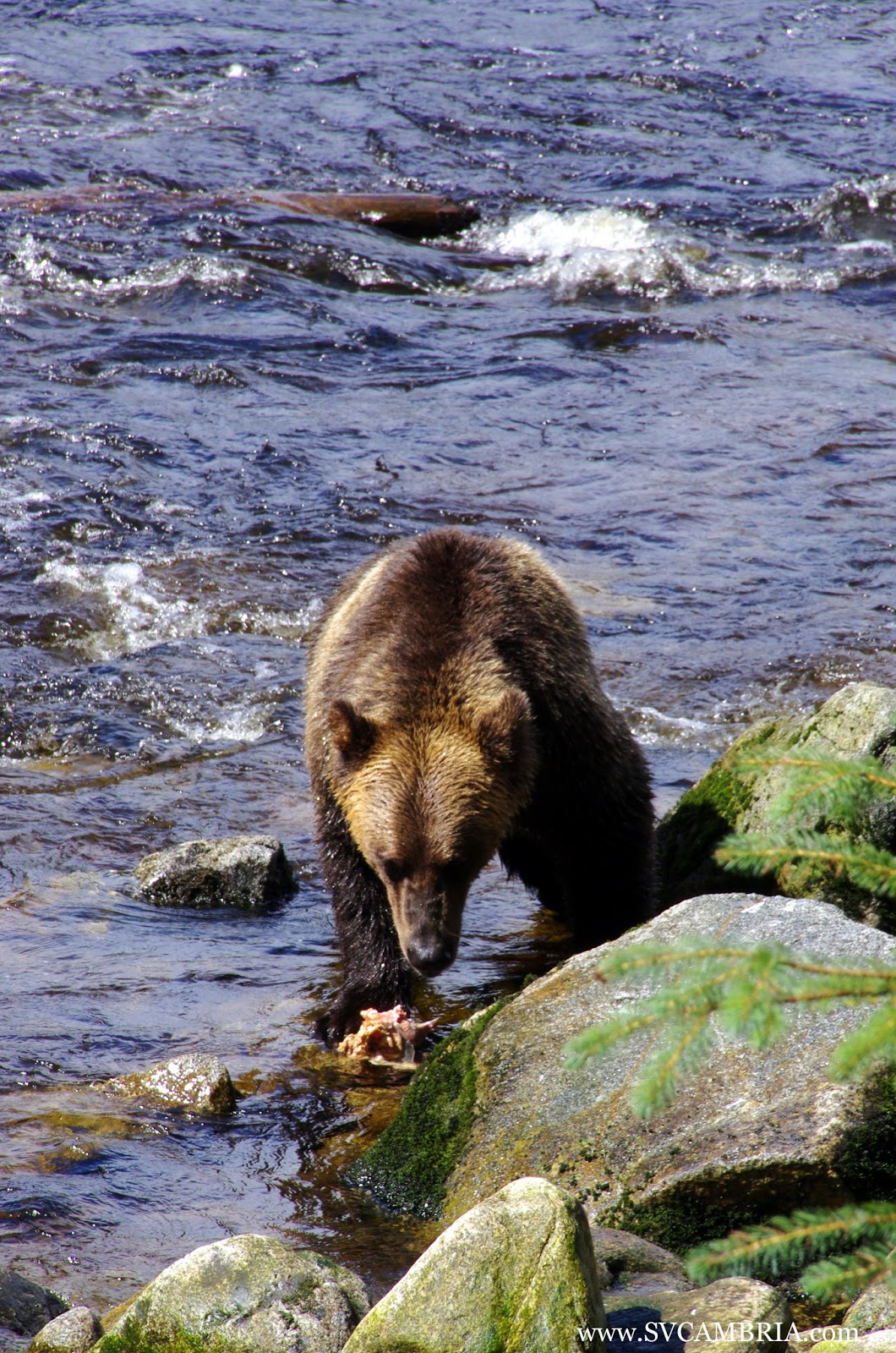
for a break. On our way to the dinghies, there was a juvenille brown male
fishing just off the trail. We did as we were instructed (talked loudly to
alert him of our presence and stayed on the boardwalk while we continued
walking) but, honestly, what I remember most about the experience is the hope
that this guy really would be more interested in fish than us and that he’d
stay put. Well, he was and he did. But that didn’t stop the adrenile from
rushing . . . or my instinct to freeze (but that may have just been an excuse
to pull out the camera).
We went
back a couple of hours later, after things had quieted down, and had the place
to ourselves (along with a Forest Service Interpreter). At first there were
three black bears fishing in the creek, but they all disappeared into the bush
about the same time. Shortly afterwards, Laurie spotted a brown bear downstream
moving toward the falls (where the fish pool). She had three young cubs with
her and was very thin . . . and very nervous. The Forest Service gal told us
that there were four cubs that morning, but the runt got separated from its
mother and was killed by a juvenille male. We watched from the bear blind as
the family made their way upstream, the cubs eager for a taste of salmon. Her
fishing wasn’t going well and they had to settle for scraps left behind by
other bears before Mom rushed them back into the bush . . . and to safety: A
larger brown male had come out to fish downstream.


Closing
time came all too quickly, and we walked back to the dinghy with the gal from
the Forest Service, calling “hey bear” along the way. We saw another grizzly
fishing just off the trail but I didn’t feel as nervous this time around, probably
because she was carrying a gun (though my instinct again was to stop). We said
our thanks and our good-byes and went back to the boats, upped anchor and made way
for Fool’s Inlet for the night, JouJou
rafting up to us again.
The day
had been one big adrenile rush and we had trouble assimilating the experience –
I mean, really, who does this? Who goes bear-watching in their spare time? I’m
sure there actually are a lot of other people who do, but that doesn’t make it
seem any more real. Not for a girl from Kansas Yorkshire , anyway. For us, it was an opportunity
of a lifetime . . . and well-worth the wait!
Note: This blog was written on Friday, 12 August 2015.
Alphabet Photography Project
Desolation Sound
Inside Passage
Alphabet Photography Project | P is for Panorama
Wednesday, January 06, 2016TheCambrians |
| Cambria alone at anchor in one of British Columbia's most popular marine parks - Prideaux Haven. |
From the Oxford
Panorama /panə'ramə/
1 An unbroken
view of the whole region surrounding an observer: 1.1 A picture
or photograph
containing a wide view.
Welcome to another installment of the ‘Alphabet
Photography Project’ and the letter P. This week was a little difficult
but, as it turns out, they all are. Not because it’s hard to come up with a
word that begins with P, or any
other letter for that matter, that’s easy. What’s difficult is coming up with
just the right photo.
In
the end, I opted for ‘panorama’ and a wide-angle look at a pretty rare sight
here in the Pacific
Northwest : a solitary
boat anchored in the hugely popular Prideaux Haven, part of the Desolation Sound Marine Park Cambria . If you’re a regular follower of our blog, you
probably already know that David and I generally seek out remote anchorages
where we can be completely alone in the wilderness. And if you’ve been
fortunate enough to spend time cruising the Inside Passage , you know that Desolation Sound is anything but
desolate so it’s a little surprising that we love anchoring there. But we do.
From
October through June, things get pretty quiet on the water, even in one of British Columbia
It’s
been a few years since we spent any time in Prideaux Haven. Hopefully our morelaid-back approach to the upcoming cruising season will find us there again
soon lazing in the kayaks, hiking the trails and (if we’re really lucky) watching bears.

Alaska
Inside Passage
Petersburg
Velkommen (Back) til Petersburg, Alaska
Monday, January 04, 2016TheCambrians |
| The Sons of Norway building in Petersburg, Alaska |
It’s
2016 and I’m bound and determined (one could say “resolved”) to catch up on the blog. A quick look through the numbers showed that I only posted 62 times last year –
a 28% decrease from 2014. And in my last entry, we were anchored in Honeydew
Cove, Alaska
Back to
Honeydew Cove . . .
When
we arrived in Ketchikan
With
visibility so low, it was a demanding morning spent watching for logs and
approaching vessels. The radar did more than its fair share of work thanks to
the high amount of opposing traffic on the water – commercial fishing boats
heading out in preparation for the next opening in the season. That was good
news for us. With the majority of boats out of port, there would be plenty of
room at the marina in Petersburg
We
weren’t able to make it all the way there without battling a head current, so
we stopped for the night in Portage Bay Frederick Sound Portage Bay
We
upped anchor the next morning at 8 o’clock to time our exit with the strong current that sits at the entrance to
the bay. Without the help of northerly winds to push us along, we slowly
motored down to Wrangell Narrows Petersburg


After filling up with diesel, we took a berth for the night in North Harbor Gig Harbor Alaska
They
extended their stay an extra night and we had dinner aboard Cambria , which always includes a quick jam session. As
luck would have it, they had some extra time on their hands before they needed
to be back in Ketchikan

Jim
and Laurie left Petersburg Wrangell Narrows 4 am . David and I prefer to take a more civilized
approach to cruising and left twelve hours later. I think we made a good
decision. Not only did we avoid the morning fog, but the tide was moving in our
favour. We did pay a small price for our languor, though. A late afternoon
departure meant we only got as far as the southern entrance to the narrows
before we had to anchor for the night. The rest would just have to wait.
Note: This blog was written on Tuesday,
04 August 2015
Notes From the Dockside
Year in Review
Out with the Old, In with the New | Year In Review (Part 2)
Friday, January 01, 2016TheCambrians
Another
year has come and gone which means it’s time to reflect upon the last 365 days. Like the ones that came before it, 2015 ended all too quickly. From start to finish, it was a whirlwind of activity full of highs, lows (mostly highs) and big numbers – including over 3,000 miles sailed and 200 days at anchor. Here's the rest of our look back on the year (if you missed the first part, you can read it here):
We Saw
Some Amazing Things
The
Inside Passage is like a geographical timeline – the further
north you travel, the younger and more beautiful the scenery becomes. 2015
brought us all the way to 59°N and the head of Glacier Bay , and every step along the way had something new
and amazing to offer. From Misty Fiords National Monument Glacier Bay and Anan Wildlife Observatory, sailing to Southeast Alaska gave us an once-in-a-lifetime experience that we
won’t soon forget.


We Spent
Time on the Water with Friends, both Old and New
We
first met Paul and Julia 12 years ago while cruising in Tonga New Zealand Alaska Pacific Northwest . Occasionally, our paths cross. A few times in
Opua and Auckland Newport Beach Las Vegas Juneau Anchorage Cambria . It may have only been four days, but they were
among the four best of our year!


This year also brought us new friends in the form of Tom, Gale and Tom’s brother, John. We first met Tom when we were still in


The
coincidences didn’t stop there. We arrived in Petersburg Gig Harbor
What’s
Next?
Do we make a run out the Strait
of Juan de Fuca and turn left, making our way down the coast to Mexico New
Zealand Panama Canal , to
the Caribbean , over to Bermuda , the Azores , and
on to the Mediterranean ? We
could truck Cambria to the Great
Lakes and do the Great Loop and Intracoastal
Waterway before crossing the Atlantic – much
like harbor-hopping up the West Coast of the US Caribbean before
crossing the Atlantic , taking the opportunity
to see Mexico Guatemala El
Salvador Costa
Rica Panama
If inland waterways and touring
countries from a unique perspective are what we’re looking for, then maybe it’s
time to try something completely different and buy a canal boat in England
It’s a big question, one we’re not
ready to answer anytime soon (not publicly, anyway). All I can really say is
that we plan drop our lines again in May and head north for one last hurrah. How
far we go will depend on the wind and the weather: Our resolution for 2016 is
to sail more . . . I hope we keep it.
Happy New Year, everyone!
Happy New Year, everyone!